Practice software
Software that speaks your medicine.
Neijing is a practice-management app for Chinese-medicine therapists and clinics — built by a practitioner, around the way this medicine actually works.
What it does
In the consulting room
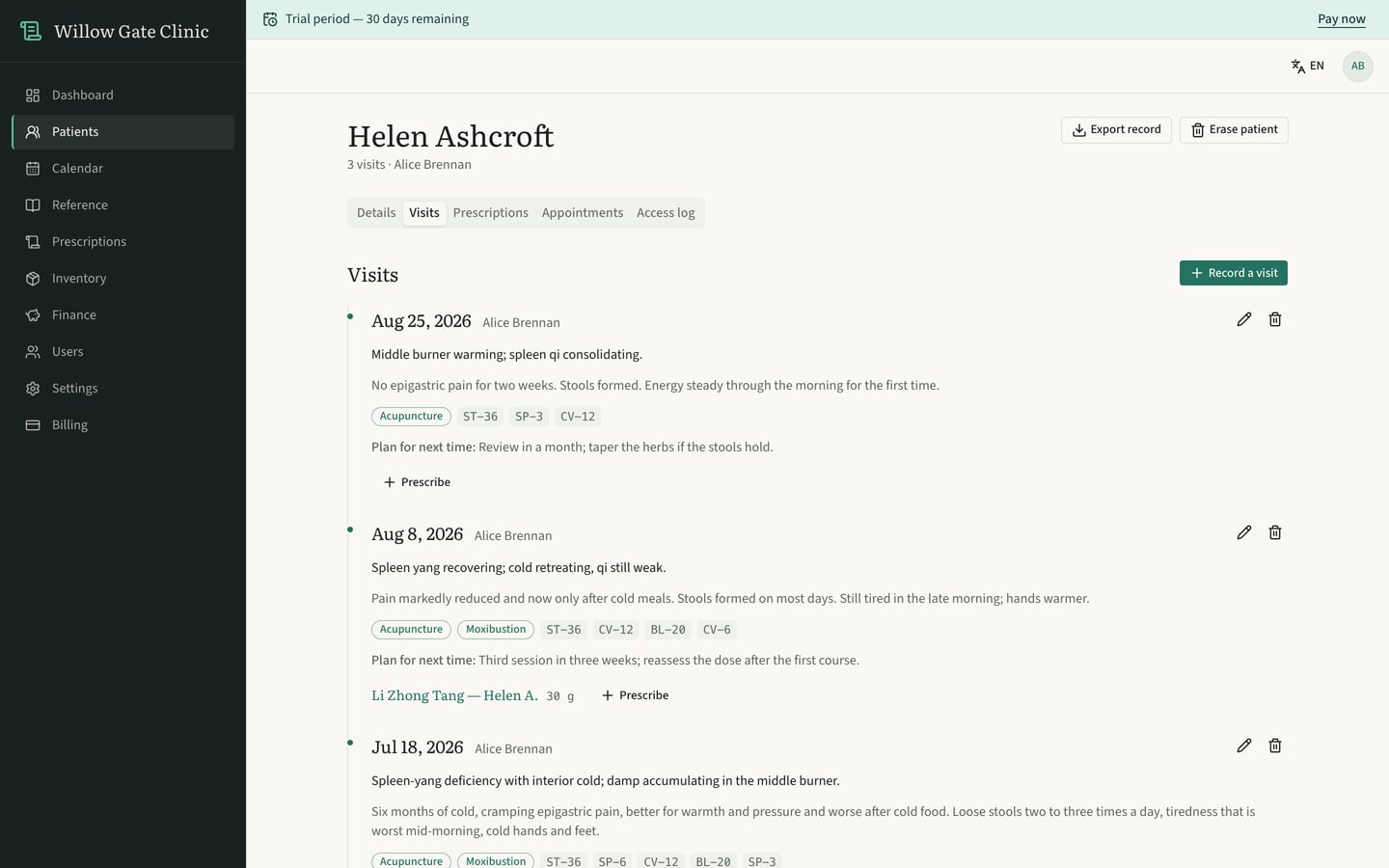
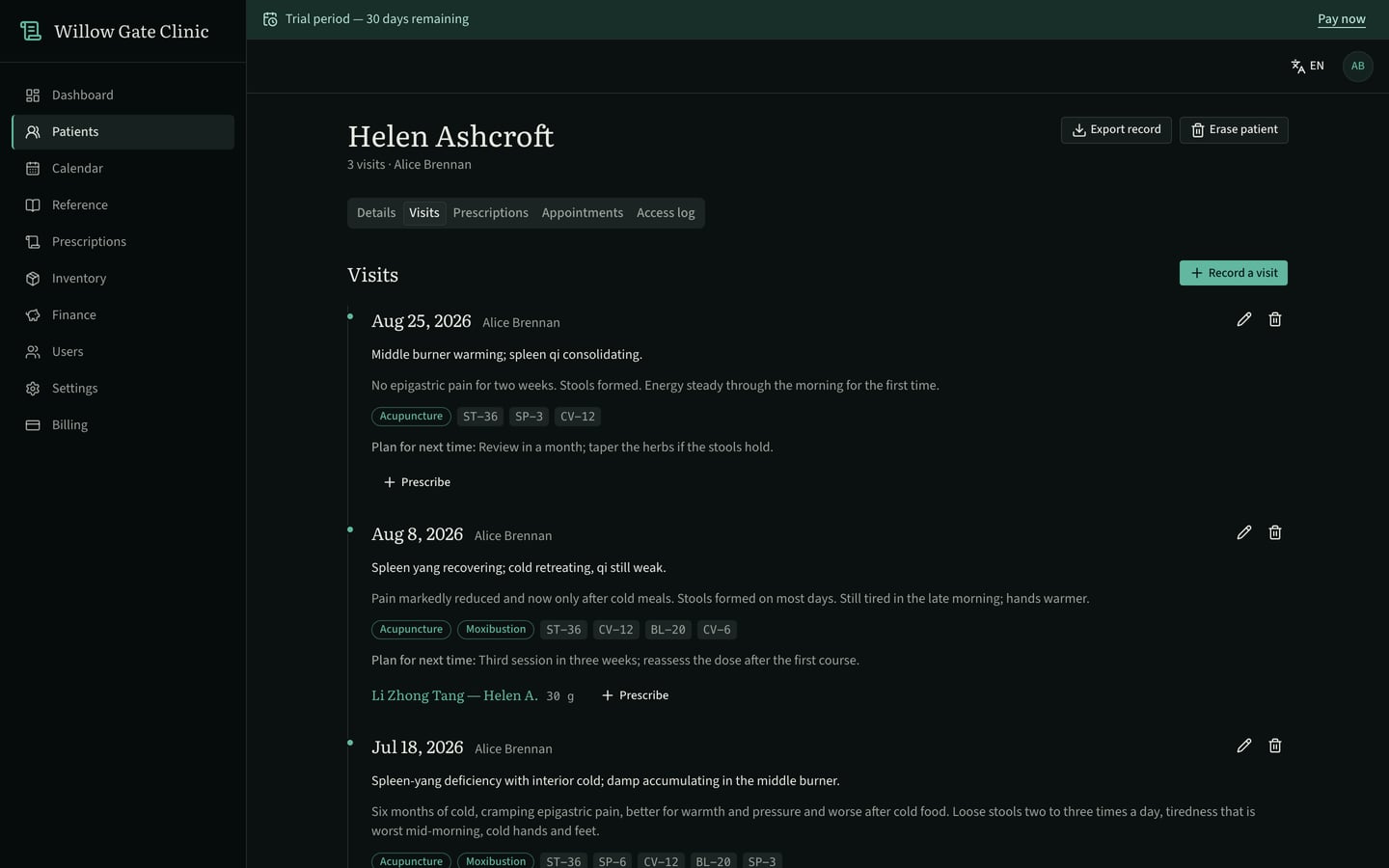
A record that reads like a course of treatment
Visits, not fields
Each visit is its own entry — what you examined, what you found, what you did. A patient's record is the sequence of them, so reading it top to bottom means reading the case, not a form somebody filled in.
Tongue photographs where they belong
Photographs attach to the visit that took them, are resized on upload, and are never served to anyone who is not signed in.
You choose what you record
Which identity fields a patient has is a clinic setting. Record what your practice actually needs — what you never collect is what you never have to protect.
Who sees whom
One shared register, or a caseload per therapist. Assistants see the schedule and the contact details and never the clinical notes — that boundary is in what the server sends, not in a hidden button.
The day ahead
Work that is planned, not only recorded
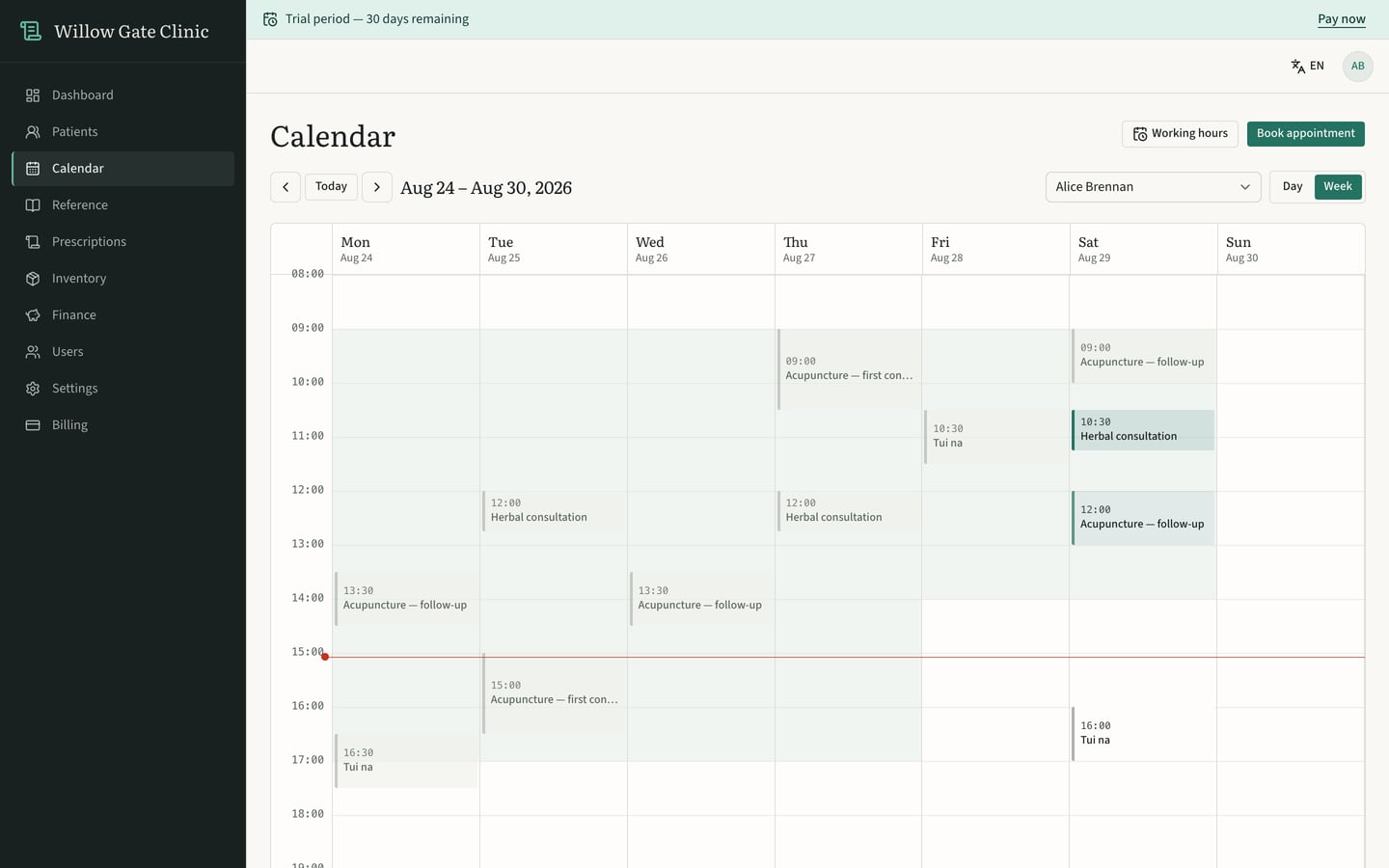
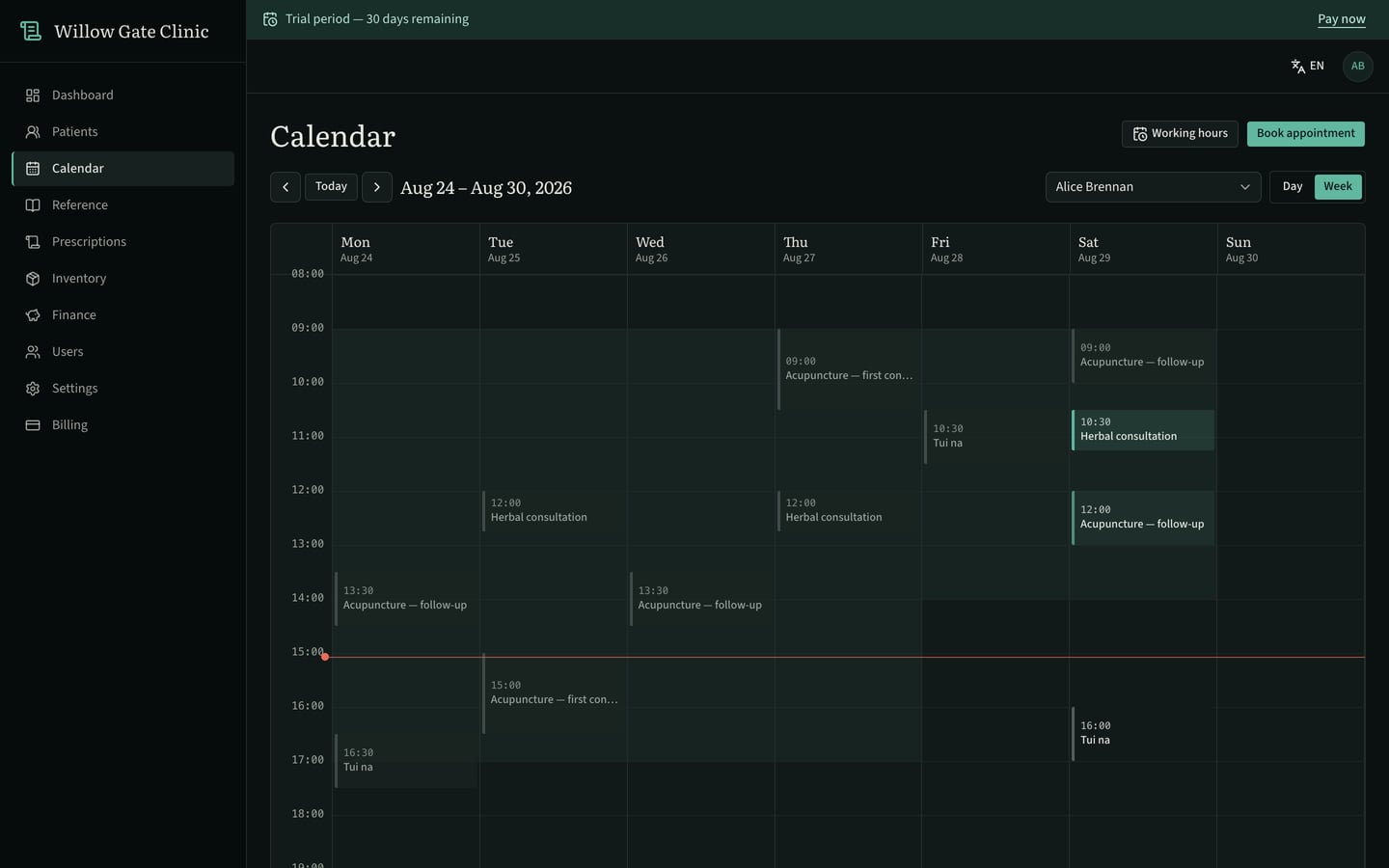
Each practitioner's own hours
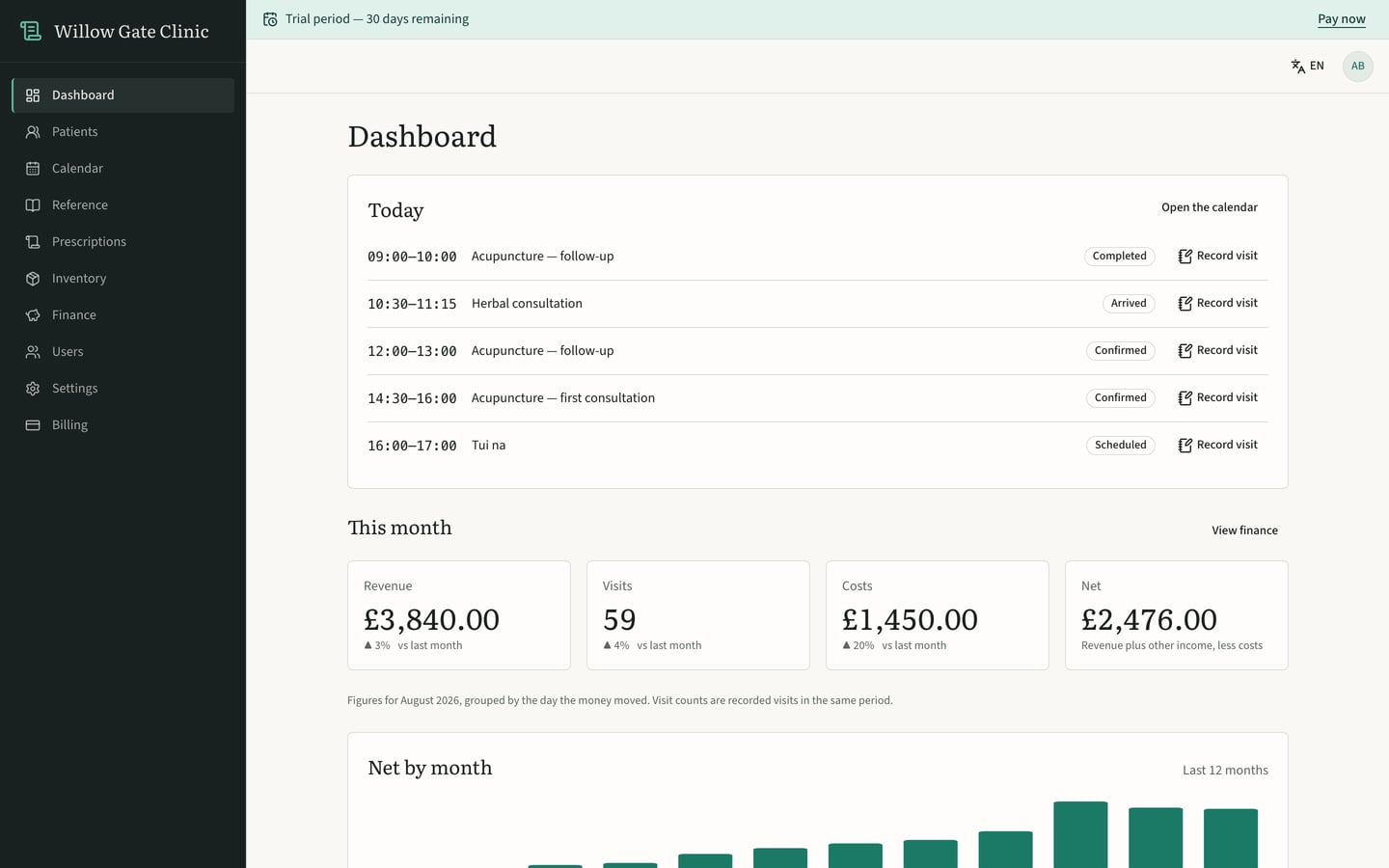
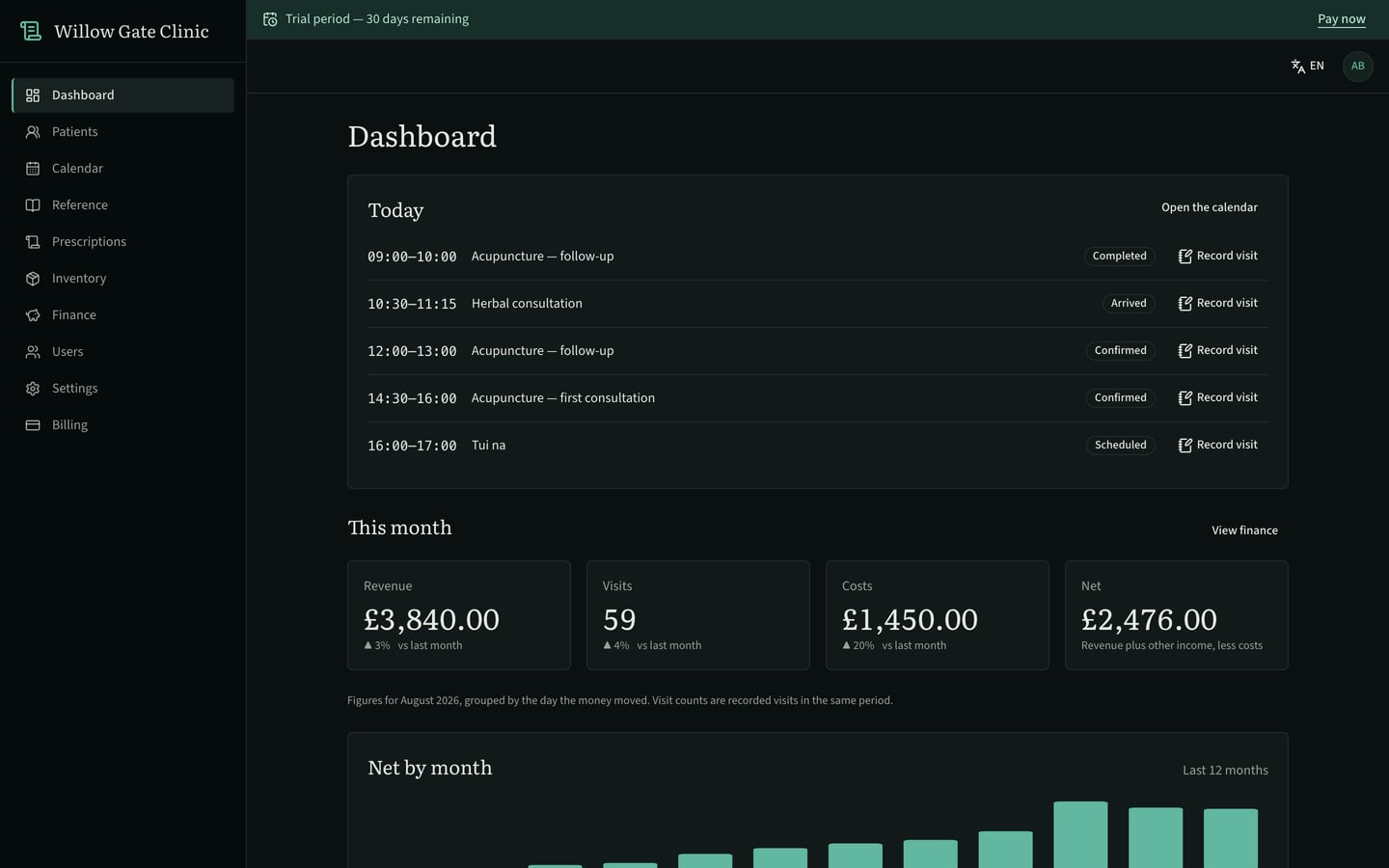
Working hours and services per person, and a calendar that books against them — in the clinic's own time zone, wherever the person looking is.
This morning's appointment becomes this morning's visit
One click turns the appointment you have just finished into the visit that records it. That is the loop a clinic actually runs, and it closes here.
Reminders your patients asked for
Opt-in per patient, sent the day before. Nobody is written to who has not agreed to be.
Google Calendar, one way, if you want it
Push the clinic's appointments to a Google calendar so your phone knows your day. Off unless you switch it on, and it never reads anything back.
A clash warns; it never blocks
Clinics double-book on purpose — an overlap is a decision, not an error. The system says what it sees and then does what you told it.
The prescription
From the formula to the sheet the patient carries home
Your formulary, next to the shared one
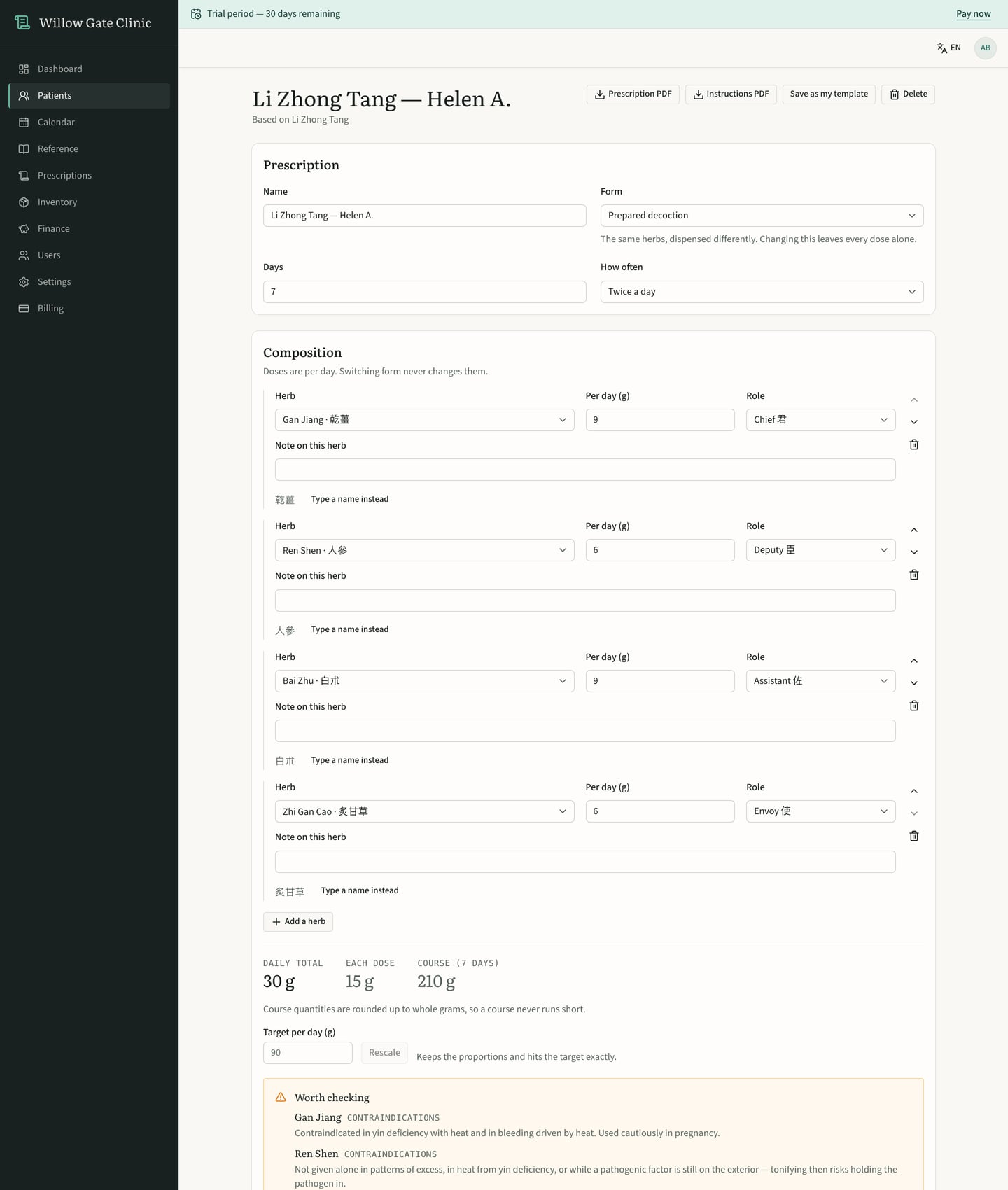
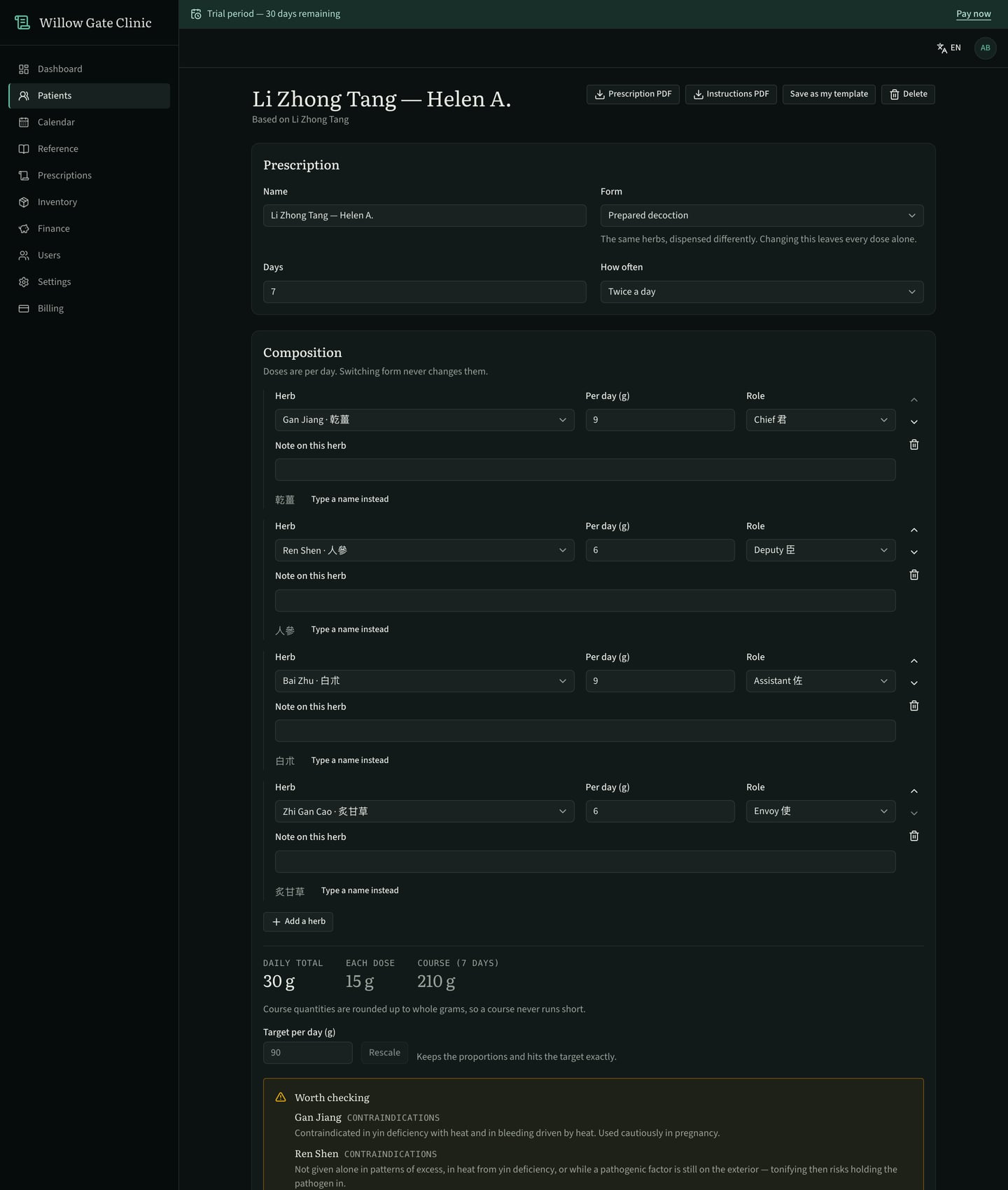
Build from a monograph in the reference or from a template of your own, and change whatever you like on the way.
Doses follow the preparation
Raw herbs, decoction or granules — switch the form and the figures convert: per intake, per day, and for the whole course.
A snapshot, never a pointer
A prescription copies what it was built from. Rewriting the template next month does not rewrite the sheet you handed someone last week.
The document, rendered on the spot
Prescription and dosage sheets as PDFs, set in a face that carries Polish and 汉字 on the same line.
Emailed only if you say so
A clinic may open that channel; a therapist still sends each message by hand. Nothing about a patient's treatment leaves on its own.
The reference
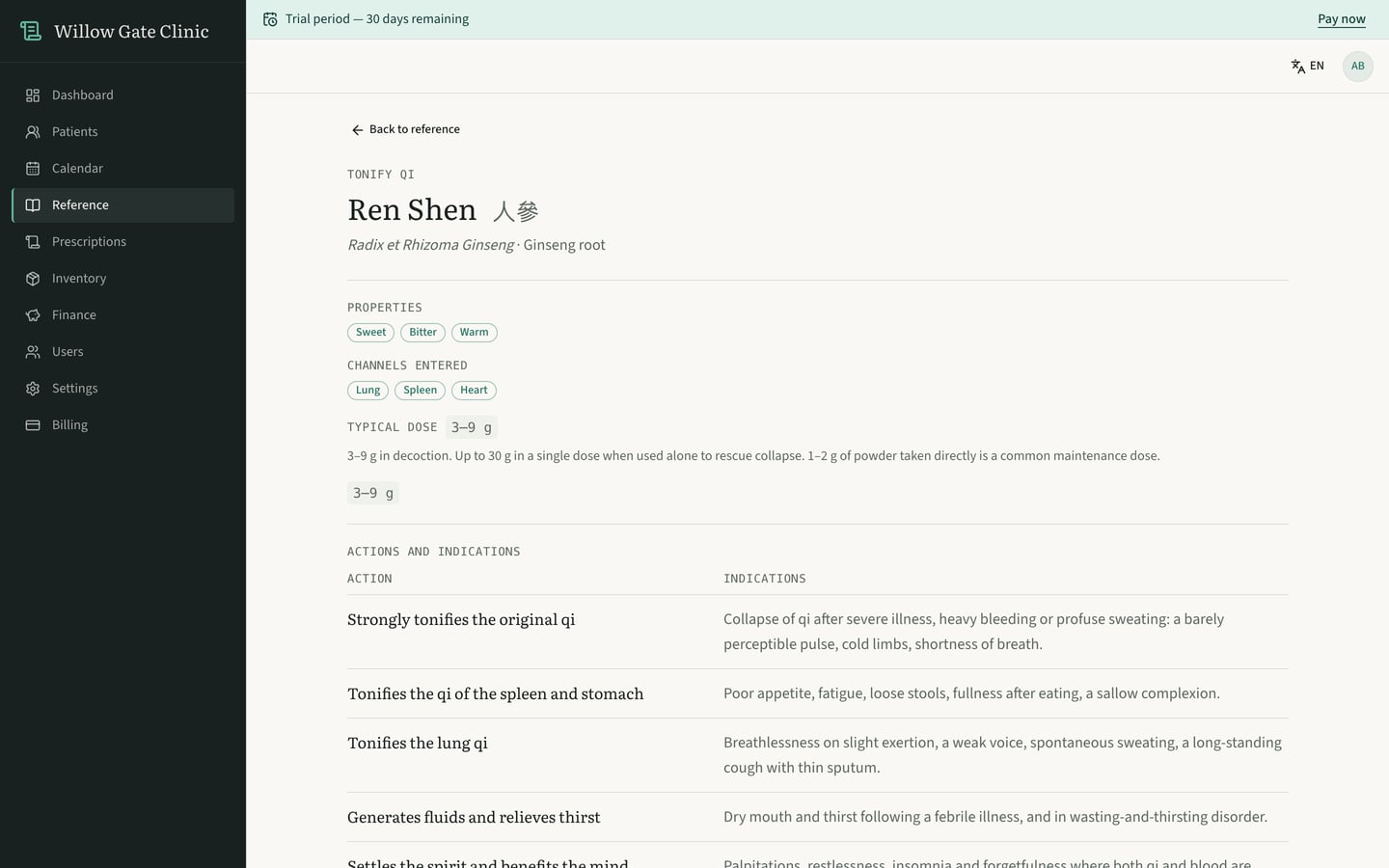
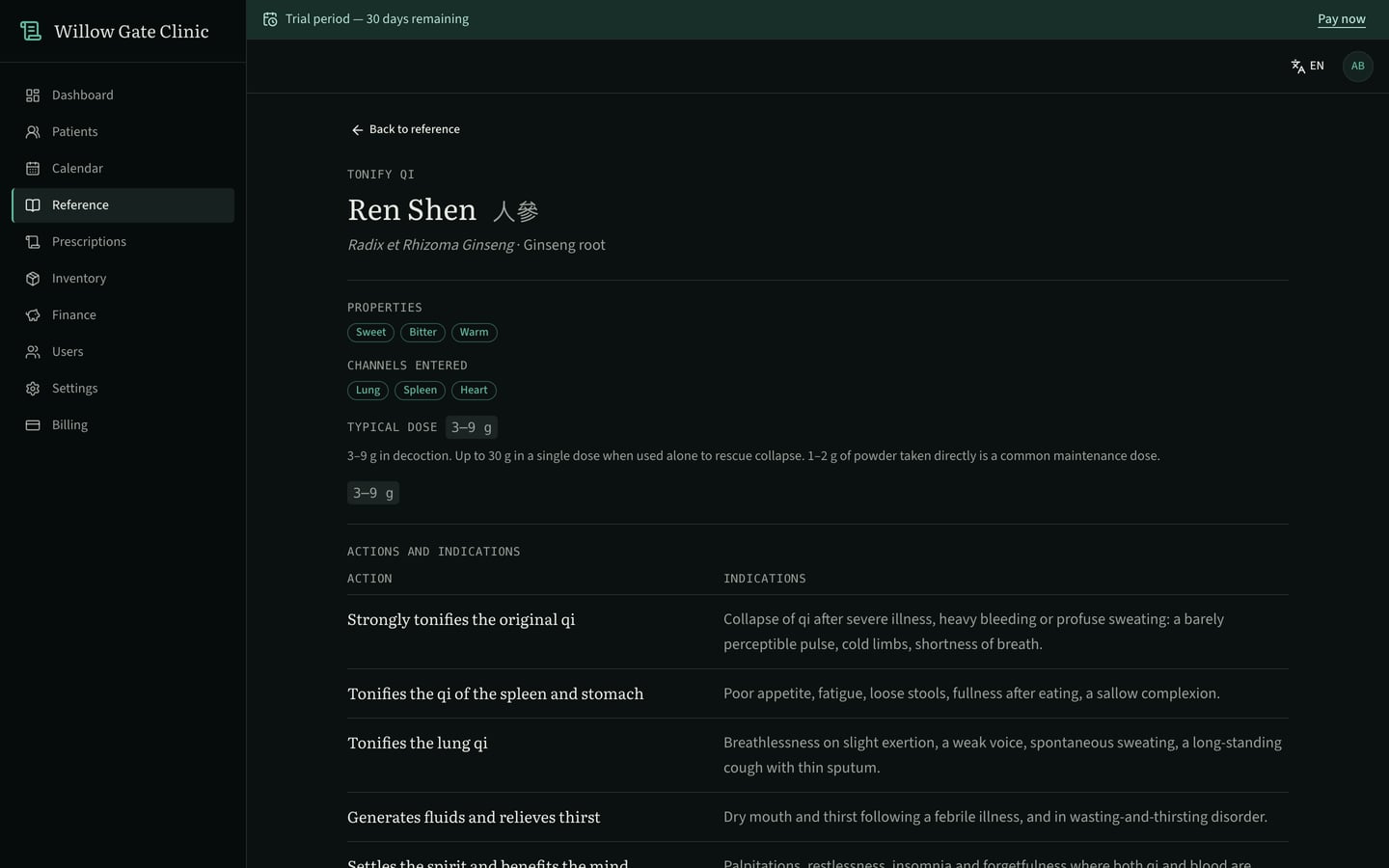
The knowledge base, a click away from the work
Herbs, formulas, points and conditions
Nature, taste, channels entered, dosage and combinations; classical formulas with their modifications; points with location, actions and cautions; and the patterns that connect them.
The same base this site publishes
What you can read here on neijing.org is what your therapists see while they work — no second window, no second subscription.
Written, not scraped
Every entry is written by hand and published one at a time. The collection is young and grows deliberately, and it is the same collection for everyone.
Yours alongside it
A clinic's own formulas and templates live in the clinic's own database — beside the shared reference, never mixed into it.
Optional modules
Two more, for the clinics that want them
Stock with an audit trail
Granules and products, changed only through a recorded adjustment — so who changed what, when and why is answerable by construction rather than by asking around.
What a visit actually used
Record consumption on the visit itself; the stock follows. No second ledger to keep in step.
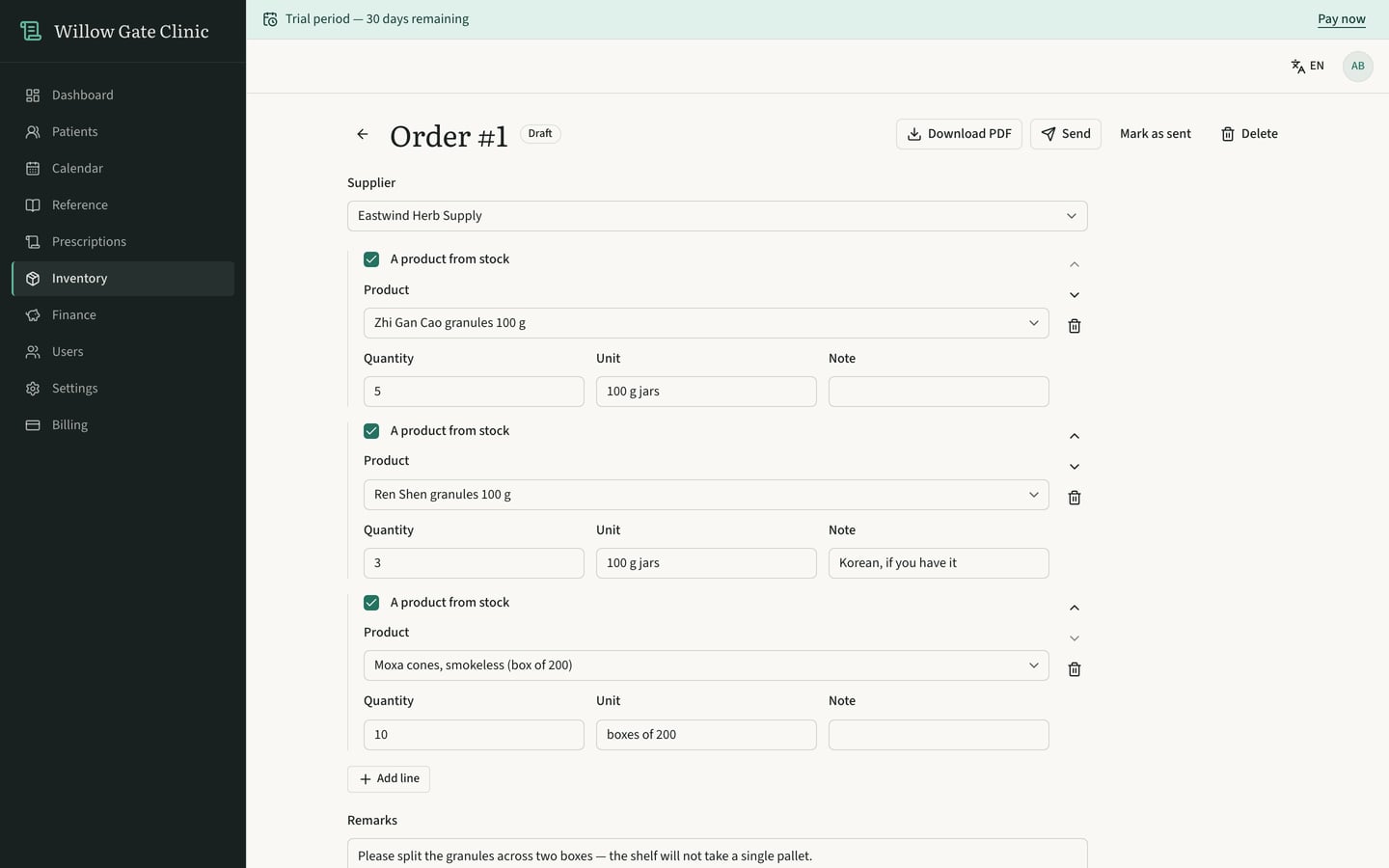
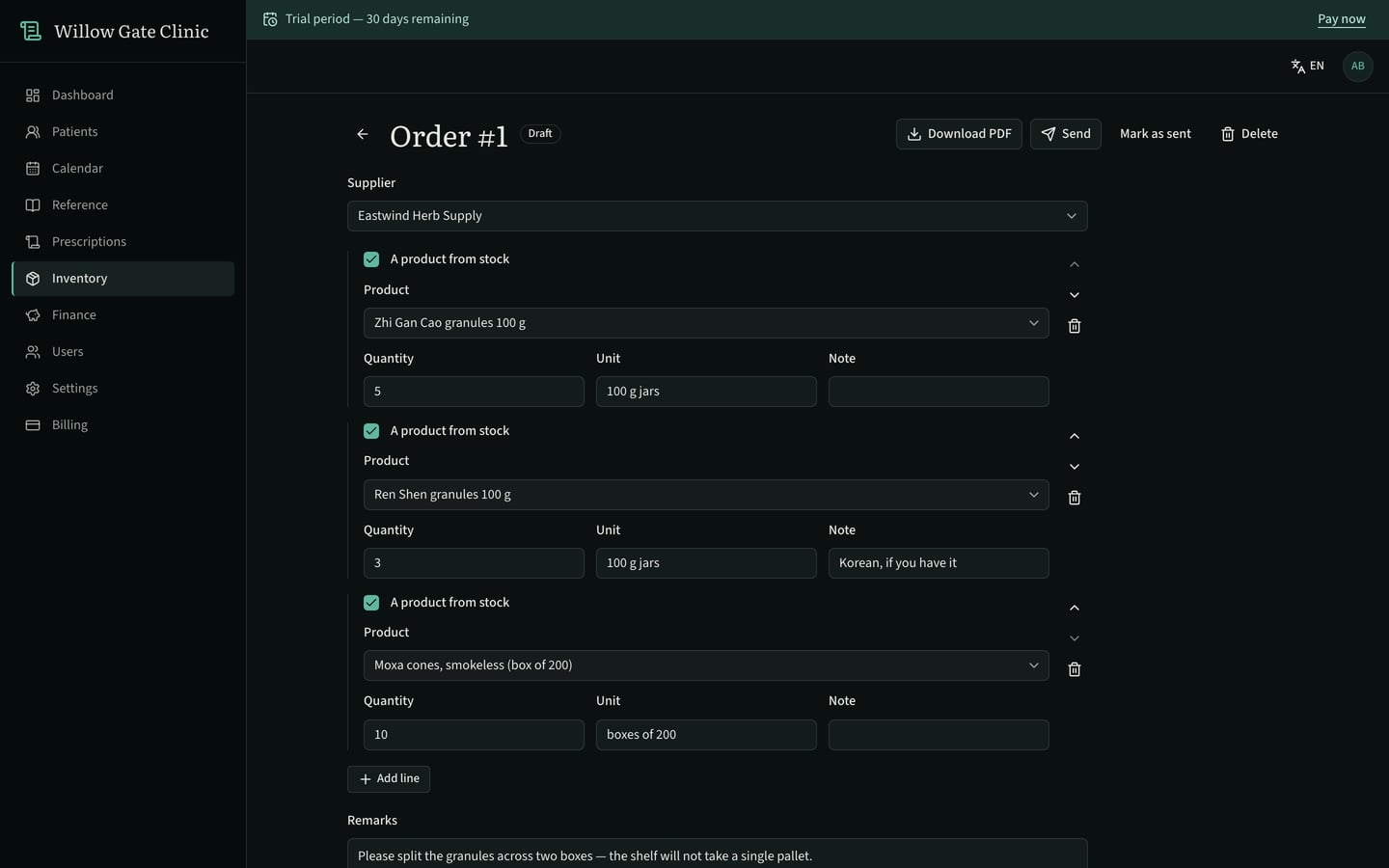
Supplier orders that leave as documents
Draft, send, receive. The order arrives in the supplier's inbox as a clean PDF, with your clinic as the reply address.
Finance, lightly
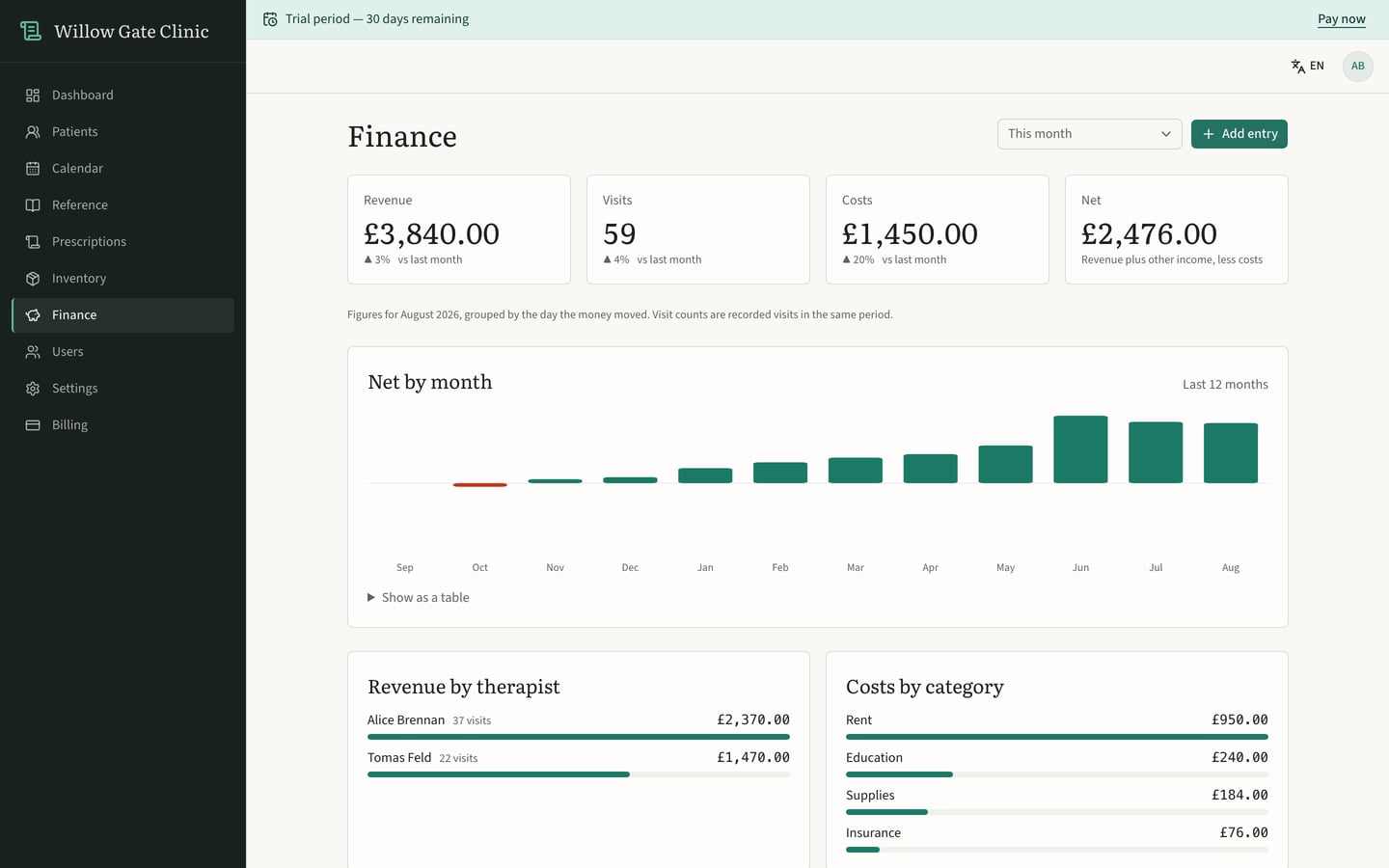
Revenue captured as a visit completes, simple expenses, one month at a time. A money view, not an accounting system — and it does not pretend otherwise.
Who sees the money
Nobody, their own, or all of it — one clinic setting. Writing stays with the owner in every configuration.
Off means absent
A module your clinic does not use disappears from the menu entirely. Switching it off hides the surface and deletes nothing.
How it's built
The parts you only notice when they are missing
A separate database per clinic
Not a column with your clinic's name in it. Your records live in their own database, reachable with their own credentials — the isolation is structural.
EU-hosted, GDPR-first
Data stays in the European Union. Your clinic is the controller and we are your processor, with a data-processing agreement and a published list of every sub-processor involved.
Export and erasure that actually work
One request gives a patient everything the clinic holds about them; one act removes it. A whole clinic can leave the same way, and take its data with it.
The patient record keeps an access log
Who opened which record, and when — written as the record is read, and kept even after the patient's data is erased.
Three roles, drawn where a clinic draws them
Owner, therapist, assistant. The assistant's clinical firewall is enforced on the server, not by hiding a menu item.
Polish and English
The whole application in both, and the clinic picks its own — including the documents it prints.
Try it on your own practice.
Every plan starts with a 30-day free trial. No card required.
Newsletter
Letters, occasionally.
New essays and knowledge-base entries, straight to your inbox. No schedule, no noise — a letter when there is something worth sending.